
I've spent years working remotely. I know what happens when you try to learn something new alone at your desk.
You open the course. Check Slack. Read two paragraphs. Check email. Start a video. Pause it. Check your phone.
Thirty minutes pass. You've learned nothing.
This isn't a willpower problem. Studying alone makes it easier to lose focus and waste time. The lack of social interaction makes sessions feel tedious. You procrastinate. Productivity drops.
I found a solution that works. Virtual study rooms.
#Why Studying Alone Fails
When you study alone, there's no external structure. No accountability. No one watching.
Your brain knows this.
Research shows that 70% of scholars said being in a study group increased their motivation to study. The data backs up what I've experienced: solo study sessions turn into distraction festivals.
You tell yourself you'll focus for an hour. You manage fifteen minutes.
The problem isn't discipline. It's environment.
When I worked at big tech companies, I noticed something. People who could work from anywhere still chose to sit in the office. Not for meetings. Not for collaboration. Just to work.
They worked better when other people were around.
Remote workers do the same thing. They go to coffee shops. They join coworking spaces. They pay money to sit near strangers because some people simply work better when other people are around them, even without direct interaction.
This isn't new. The Hawthorne Effect, discovered in the 1920s at a Chicago factory, revealed that workers became more productive simply because they knew they were being observed.
Your brain focuses better when it knows someone might notice if you don't.
#What Virtual Study Rooms Actually Are
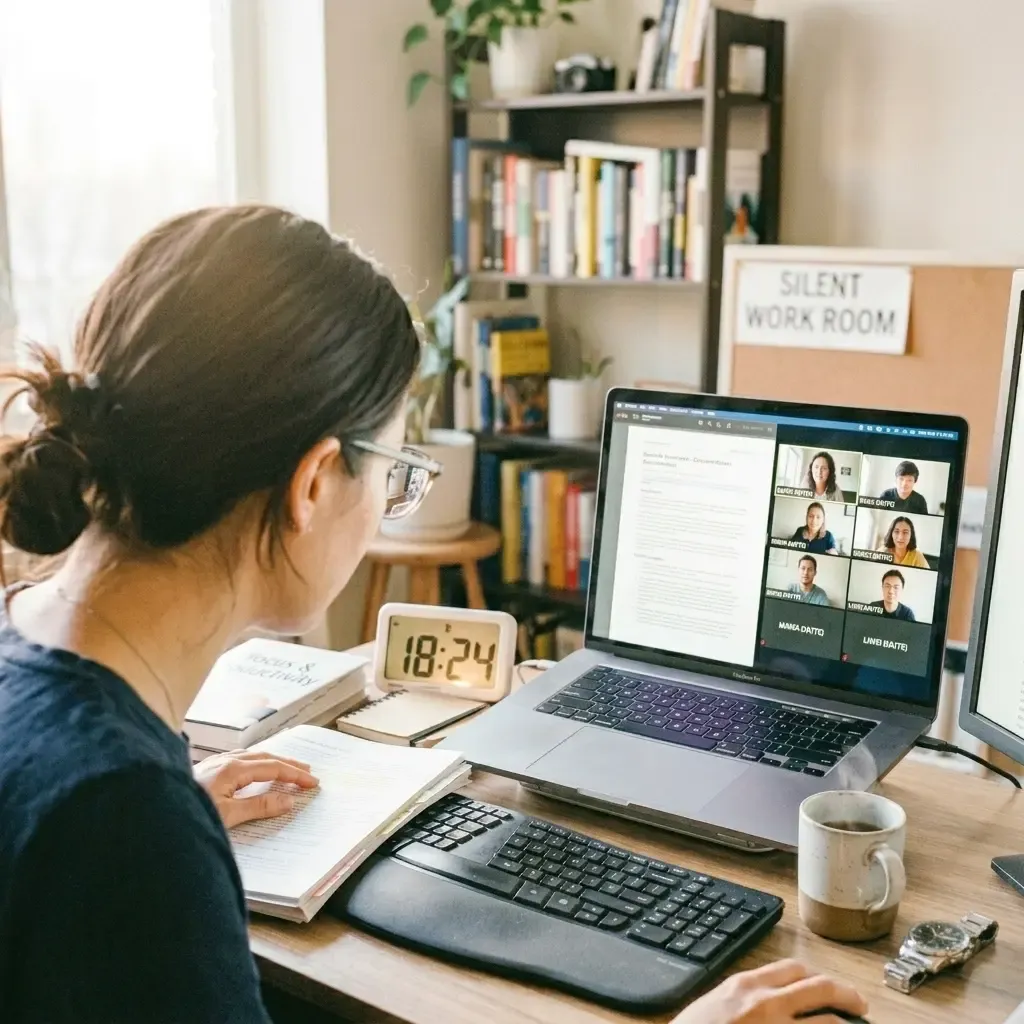
A virtual study room is a shared online space where people study together in silence.
That's it.
No teaching. No meetings. No pressure to interact.
You join a room. Turn on your camera. Mute your microphone. Work.
Everyone else does the same. You see them. They see you. You all work in parallel.
The best virtual study rooms add structure. A shared timer. Pomodoro intervals. Fixed blocks of 25-50 minutes with short breaks.
This creates rhythm. You know when to focus. You know when to rest. The decision fatigue disappears.
Search interest in "Study With Me" videos tripled in the last five years. People want this. They're watching strangers study on YouTube because it helps them focus.
Virtual study rooms take that concept and make it interactive.
#Benefits of Silent Co-Working
I was skeptical at first. How does watching someone else work help you work?
Then I tried it.
Body doubling works. It creates accountability and provides a model of focus. Watching other people study serves as a living reminder of what you're meant to be doing.
A 2024 study found that body doubling helps with initiating and completing tasks, especially for individuals with ADHD. Lab and field studies reported faster task initiation when another person is visibly present.
But it's not just for ADHD. It works for anyone who struggles with focus.
Here's what I've noticed:
-
Immediate accountability – You can't check Instagram when five people can see your screen reflection in your glasses
-
Reduced isolation – Learning alone feels lonely. Silent co-working gives you presence without distraction
-
Consistent rhythm – Shared timers mean you don't negotiate with yourself about "just five more minutes"
-
Higher completion rates – Students who engage in active study sessions are 30% more likely to succeed in their courses compared to those who study alone
The structure matters too.
Groups using fixed 25-50 minute blocks with visible timers and short breaks show higher perceived productivity and lower drop-off in hybrid coworking trials.
Time-structured Pomodoro interventions consistently improved focus, reduced mental fatigue, and enhanced sustained task performance. A personal study found that implementing the Pomodoro Technique resulted in a 46% decrease in distractions and a significant increase in motivation.
The numbers don't lie. Structured focus works.
#Examples of Virtual Study Room Platforms
Several platforms offer virtual study rooms. They vary in features and structure.
Study With Me videos on YouTube – Free, but one-way. You watch someone else study. No interaction. No accountability beyond what you create yourself.
Discord study servers – Community-driven. Free. Casual. You join voice channels and work alongside others. Structure depends on the server. Some are chaotic. Some are focused.
Focusmate – Scheduled 50-minute sessions with one other person. You both state your goals at the start. Work in silence. Check in at the end. Good for accountability. Limited to pairs.
Study Stream – Larger groups. Pomodoro timers. Chat features. More social than some alternatives.
Each platform has trade-offs. Some prioritize community. Some prioritize structure. Some prioritize simplicity.
I've found that the best virtual study rooms share three characteristics:
-
Cameras on by default (presence matters)
-
Microphones off (silence is the point)
-
Shared timers (structure keeps you honest)
If you're a self-directed professional learning independently or through online courses, you need more than just a video call. You need an environment designed for focus.
That's what Study Hall provides. Small groups. Silent study rooms. Shared Pomodoro rhythm. No meetings. No teaching. Just shared presence that creates focus and consistency.
It's a virtual library for professionals who want to actually study, not just plan to study.
#When Virtual Study Rooms Work Best
Virtual study rooms aren't for every situation.
They work best when you need to:
-
Process information – Reading documentation, watching course videos, working through tutorials
-
Build consistency – Showing up at the same time creates habits
-
Combat isolation – Remote learning feels lonely. Silent co-working fixes that
-
Eliminate decision fatigue – Shared timers mean you don't negotiate with yourself
-
Increase completion rates – Accountability helps you finish what you start
They don't work well for:
-
Active collaboration (use regular video calls)
-
Creative brainstorming (silence limits idea exchange)
-
Tasks requiring frequent interruptions (defeats the purpose)
I use virtual study rooms when I'm learning new technologies, reading research papers, or working through online courses. The structure keeps me honest. The presence keeps me focused.
You don't need perfect conditions to learn. You need consistent conditions.
Virtual study rooms provide that.
#The Bottom Line
Studying alone fails because your brain needs structure and accountability.
Virtual study rooms provide both. They create an environment where focus becomes easier and consistency becomes natural.
You sit down. You work. You make progress.
That's how real learning happens.
If you're a professional learning on your own and want a quiet, reliable way to actually study, try a virtual study room. The data supports it. The experience proves it.
You'll be surprised how much you get done when someone's watching.